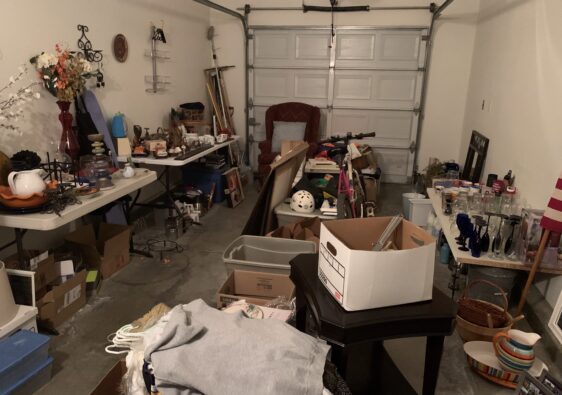
A few years before we moved into Ocean Hills Country Club, we did something a little unusual. We decided to completely redesign our lifestyle. We moved from a 2,400 square foot home — three bedrooms, three bathrooms, full garage, full closets — into an 800 square foot apartment. One bedroom. Tiny storage. On purpose.
We called it Project Downsize. And what we didn’t expect was how much the process would reveal — about our stuff, about the decisions we’d been quietly avoiding, and about how much lighter life could feel when you stop holding on to things that no longer belong in your next chapter.
That experience is part of why we take this subject seriously. And it’s why a recent experience with a client made us stop and reflect again about how easy it is to let things collect.
What We Just Watched Happen
A client recently lost her mother. The home — inside Ocean Hills Country Club — needed to be cleared out before it could sell. Our client lives out of state. She was managing everything from a distance, relying on us for things that went well beyond real estate.
What unfolded was a process that most families aren’t prepared for. And the part that surprises people the most isn’t the emotion — she knew that was coming. It was the logistics.
After the family removed items they wanted from the home, the rest was to be donated to a specific charity. The question at hand was how to make that happen.
Here’s what she learned:
Donation centers will take almost anything that can be boxed up and carried by one person. Dishes, bedding, books, small appliances, towels — all of that moved relatively smoothly. But the furniture? That’s where things get more complicated.
Large items — sofas, dressers, bed frames, dining sets — require a different kind of removal entirely. The estimate she received to have the remaining furniture picked up and delivered to the charity: $1,900.
The developer purchasing the home offered to haul everything away for free. In that scenario, you don’t know specifically where things end up.
This created an unexpected dilemma for our client. It’s a tough spot to be in when you’re juggling the role of ensuring everyone gets their fair share of the estate. There’s no perfect answer. And there’s no way to know, standing in that living room, which choice your mother would have wanted.
This is the part nobody tells you about.
The Home That Told a Different Story
Around the same time, we were working with another home inside OHCC. Different circumstances entirely.
Walking in, you felt it immediately. The right amount of everything. Thoughtful upgrades made over the years. A home that had been cared for with intention — not frozen in time, not cluttered with decades of accumulation, but genuinely lived in and loved.
It showed beautifully. It is selling for top dollar.
That contrast — two homes, two completely different experiences — is something we keep coming back to. Because the difference between them wasn’t luck. It was years of small, consistent choices.
Why Spring Is the Time to Start
This time of year, something shifts. Maybe it’s the longer days. Maybe it’s something deeper — the instinct to open windows, clear out what’s been accumulating, make room for what comes next.
Whatever the reason, spring is when most people feel most ready to actually do something about it. And if a move — even a distant, someday move — is anywhere on your horizon, that instinct is worth following.
Not because you need to rush. But because starting early is one of the kindest things you can do for yourself and for the people you love.
A few places to begin:
- Start with one category, not one room. Towels. Books. Kitchen gadgets. One category at a time keeps the process manageable and builds momentum.
- Use the one-person rule for donations. If it takes more than one person to carry it, it’s a furniture problem — plan for that separately and early.
- Do one pass per season. A single annual sweep through each area of your home keeps things from quietly accumulating year after year.
- Ask the right question. Not “do I still like this?” but “does this belong in the life I’m moving toward?” That question cuts through a lot of indecision.
- Start with what’s easy. Bathroom drawers. The linen closet. The pantry. Early wins build confidence — and confidence builds momentum.
We Made a Guide for This
When we went through our own Project Downsize, we learned a lot — about what works, what doesn’t, and what we wish someone had told us before we started. We turned all of it into a free guide: the philosophy behind right-sizing, a 30-day kickstart plan, and a simple keep vs. release checklist for when decisions feel fuzzy.
It’s called Downsizing, Simplified — and it’s for anyone thinking about this, even quietly, even years from now.
Download it below. It’s free, it’s practical, and it’s written from experience — not theory.
→ Download: Right-Size Your Next Chapter — A Practical Guide to Downsizing, Simplified
Downsizing is an ongoing process and you can never start early enough.